Dornafield

For Caravans & Camping


   Best of British Caravan Sites


Home

Site plan

Tariff

Brochure Request

On Line Bookings

Awards

History

Dutch

German

Contact us

Links

Best Of British

Clay Pigeon Shooting

Access Statement

How To Find Us


Dornafield

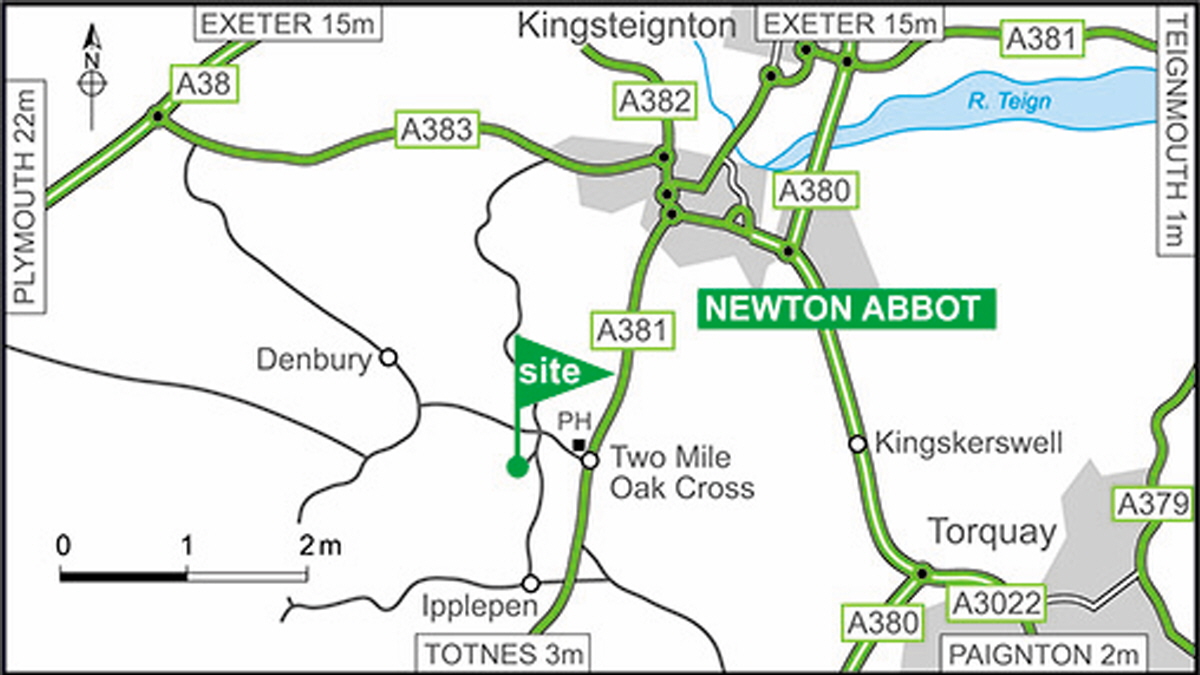
It is on the very edge of the parish boundary of Ipplepen among low hills just off a country road which runs from an Inn at Two Mile Oak cross, on the A381 south of Newton Abbot, to Denbury.

The location has attracted man for thousands of years. His stone slabbed burial chambers, protected by round barrows of earth dating from the first millenium B.C. when he was shaping his implements from iron, lie at the top of rising ground a little to the east.

There is a popular belief in the village that the boundary between the parishes of Ipplepen and Denbury passes through the middle of Dornafield, but the son of the farms bailiff in 1920's who still lives in the village assures us that this is not so.The boundary passes at the side of the house and could not be followed by the bound beaters at this point, as it was overgrown with thicket and brambles, so his father permitted the men passage through the house. Hence the myth arose that by passing from one room to another one could walk from Denbury to Ipplepen.

No dwelling is recorded here in the Domesday Book (1086), but the Assize Rolls tell us that by 1238 a dwelling had been established and a Roger de Dornafield was in possession. Nearly one hundred years later the Devonshire Lay Subsidy of 1332 shows that Robert de Dornafield was taxed to a sum of 2 shillings a figure exceeded by only two in the parish.

The ground floor of the house contains a classical example of a typical Devon late medieval single storey farmhouse plan adopted by early farmers both on Dartmoor and the surrounding countryside comprising  three rooms and a cross passage. A hall, the main room for the family ; a shippen for the animals at a slightly lower level divided from the hall by a partitioned cross passage; and a parlour, a small room partitioned off at the other end of the hall.

In the times of early owners these rooms were open to the roof, evidences of which is provided by the old cruck roof timbers hidden by later ceilings   blackened by smoke from a centrally placed hearth in the hall. The cross passage would have had a wider door at the rear for the animals to enter the shipen. The material for the walls, from the first was probably stone as there is an abundance of small lime stone quarries in the vicinity. Earthern floors were made as comfortable as possible with straw and reed. The small windows would be closed with shutters. Few farms had the comfort of glass before 1600. Originally the roof was possibly thatched, although the local quarries would produce tolerable roofing slates which may have been used from the beginning.

These early farmers knew the importance of selecting a site with the right characteristic, like those existing here, before expending their energies on building; a farm base, preferably rocky; a ready source of building materials; the ground slightly sloping towards the shippen where the animals were to live, for natural drainage. Before turning the animals out at some date in the 15th century and converting the shippen to a dairy or kitchen, the Devon farmer and his animals had lived under the same roof for centuries.

It would have been like this in the times of Roger and Robert. How long Roberts descendants remained is not known. The parish registers tell us that Thomas Stephen's was the farmer in 1606.

The hundred years after c1540 were particularly prosperous for farming, and Devon farmers, like farmers all over England, found themselves steadily accumulating more wealth than their forefathers had ever seen. With this abundance of ready money farmers everywhere were active enlarging and modernising their medieval farmhouses or buildings for new ones.

The large cereal barn at the rear of the house was an early priority in those prosperous years, followed by major improvements within the house by inserting another floor reached by stairs from the old cross passage. As a result the accommodation was doubled but with some restriction to headroom. The new floor made it necessary to move the old central hearth to a side wall and provide a Chimney. The massive new chimney stack was a prestigious addition and displayed with considerable effect when projected from the long front wall by the entrance. Another hearth and chimney were added to the end wall of the shippen, turning it into a kitchen, with an external projecting traditional stone bread oven along side.

Drip stones were not apparent between the roof and the chimney stacks indicating that slatestone, rather than thatch was the roof covering,   at least from the time of this affluent period between the mid 16th and 17th centuries. The slatestone  ground floor paving, which replaced the earth and reed, contain interesting impressions of small fossilised sea creatures millions of years old.

A two storey wing joining the north end of the house to the cereal barn, originally stores, converted more recently for living, would appear to be the final stage of this intensive period of the farms development. The roof of the wing is covered with small older slates. The rest of the house has been resulted with Welsh slates probably in the second half of the 19th century.

  Cider making was a widespread farm activity in the 18th and 19th centuries, often assisted by animal power. There is evidence of this in the form of a low beam with a hole for axle of the mechanism for crushing apples, at the end of one of the smaller barns.

  Reference again to the parish registers tells us of other early families farming at Dornafield  in the 17th and 18th centuries among whom were the Jannes and the Crossings. Let into the floor of the church in Ipplepen is a slab stating that William son of William Crossing junior was baptised and buried in 1650, also Elizabeth daughter of John Crossing, gentlemen of Dornafield, was buried in 1692.

  In the Devon Protestation Returns of 1641 Richard and William Crossing of Ipplepen had declared to the Faith and their King a declaration that was possibly responsible for disturbing the peace of Dornafield as never before or since.

  In the winter of 1645/46 the Civil War was drawing to a close. Exeter was under siege by Oliver Cromwells army, and was soon to fall. to the south it was necessary to secure the Port of Dartmouth. Leaving a force to keep Exeter blockaded, Cromwell moved south in the evening of January 9th 1646, surprised royalist troops in Bovey Tracey and captured the town. Cromwell's general Sit Thomas Fairfax then pushed on with troops of horse to occupy Ashburton and Totnes which had been abandoned by the Kings forces to take up defensive positions in Dartmouth. On January 18th Dartmouth was stormed and fell to Fairfax within hours.

On the whole, Devon was more parliamentary inclined than royalist. It is broadly true to say that the peer and greater gentry were on the Kings side, and the lesser gentry and townspeople stood for parliament. Yet there were many exceptions and even some families were divided .

  Having secured the Port Of Dartmouth, fairfax retraced his steps to Totnes and was heading back to Exeter through Newton Abbot. Other than Compton and Powderham Castles, which were fortified royalist establishments, the smaller dwellings along this route did not attract, unduly , the attention of his troops. But the Crossings declaration of loyalty to the Crown in the protestations Returns five years previously would appear to have been known to the parliamentary forces, because Fairfax decided that the occupants of Dornafield needed flushing out, presumably assuming that they may have been sheltering a small party of royalist soldiers.

  Either there was some resistance or the parliamentary troops were taking no chances as they decided to bring up cannon in support of there small arms bombard   Dornafield with cannon ball, many of which were dug up in the early part of this century and stacked in pyramids in front of the house. Unfortunately they have been removed by souvenir hunters during a period when the property was unoccupied. The Reverend Robert Cooke in his notes on the parish in 1924 recorded that shot marks could be seen on the entrance door. It is unfortunate that the door has since been removed. The present door is of more recent date.

  The Crossings evidently survived the siege as indicated by their monumental inscriptions of later dates in the parish church, and the commemorating of the repairs of the house, including the wide and impressive porch with a room over, by John Crossing who had his initials carved on the keystone of the granite arch to the porch opening with the date 1664.

The Crossings remained until the first half of the 18th century. More recently in 1831 the Sowton family were in occupation. In c1850 the Nichels family took over the farm, and Mr George Henery Nichels, born 1893 and still a sprightly 87 years, living in Maidencombe, tells us they stayed until 1903.

  Since then it has been farmed by members of the families  of Hopkins, Martin, Vallance, White, Cawper, Shewens, Wyatt and Hubbard before coming into the possession of Mr & Mrs Dewhirst who are dedicated to maintaining the buildings ancient charm and character.

Paul Presswell ARIBA   (retd)

FOOTNOTE

Dornafield is but a mile from Denbury village and little more from the ancient Denbury fort. It is authoritatively Stated that Denbury is the only Devon village which retains its Celtic name, Denbury being a corruption of Defnas Burgh, meaning the fort of the men of Devon. History has it that about 710AD, Geraint, the last of the British Kings of Devon was killed here, while making a final stand against the Saxons, and was buried on Denbury Down. This gave rise to the couplet handed down by word of mouth: "Whoever delves on Denbury Down is sure to find a golden crown".

Dorna comes from the Celtic tongues; in Cornish it is the verb to thump or thrash; in Breton it is to strike with the hand ; in Welsh the noun dyrm is fist, and the verb dyrni is to box.

Field derives from the anglo Saxon feld.

The slight depression between rising ground around Dornafield, would have provided a natural amphitheatre for combat practice for the fighting men of ancient Denbury Fort, with good viewing for the spectators. It would appear that this activity gave the place its name.